Is Die Casting Cheaper Than Injection Molding / CNC Machining? A Comprehensive Cost & Process Comparison
When engineering new products or scaling up hardware manufacturing, choosing the right production technology is critical to long-term profitability. Design engineers and procurement teams frequently ask: Is die casting cheaper than injection molding or CNC machining? The answer depends on production volume, material selection, part complexity, structural strength needs, and upfront Die Casting Mold tooling investment.
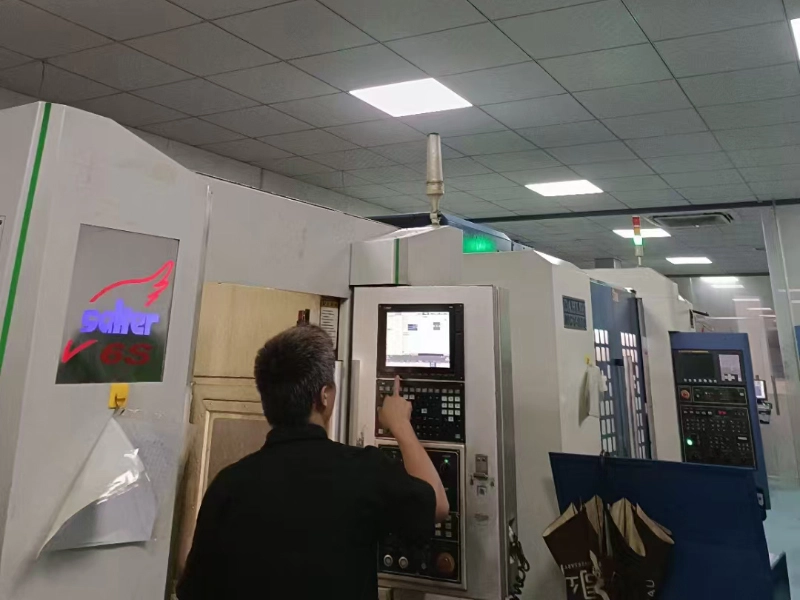
As a leading precision mold accessory manufacturer, Dongguan Hairong Mould Technology Co., Ltd. develops high-precision cores, cavities, inserts, sliders, thread cores, and custom non-standard hardware/plastic mold components. Utilizing Sodick mirror spark EDM, Mitsubishi wire EDM, Mazak CNC lathes, and Zeiss 3D CMM inspection systems, we support high-precision mold development across medical equipment, daily chemical packaging, and industrial hardware sectors with strict tolerance control maintained within 0.003mm.
In this detailed comparison guide, we evaluate die casting mold tooling and unit costs against plastic injection molding and subtractive CNC machining to help you make an informed manufacturing decision.
Table of Contents
- 1. Manufacturing Process Fundamentals: Die Casting vs Injection Molding vs CNC Machining
- 2. Initial Tooling & Setup Cost Comparison
- 3. Per-Unit Production Cost Analysis across Production Volumes
- 4. Material Cost, Structural Strength, and Mechanical Properties
- 5. Design Flexibility, Precision Tolerances, and Finishing Costs
- 6. Production Speed, Cycle Times, and Scalability
- 7. Detailed Process Comparison Matrix: Die Casting vs Injection Molding vs CNC
- 8. How Hairong Mould Technology Delivers High-Precision Tooling Accessories
- 9. Frequently Asked Questions (FAQ)
1. Manufacturing Process Fundamentals: Die Casting vs Injection Molding vs CNC Machining
To evaluate which process is cheaper, we must first examine how each manufacturing method transforms raw materials into finished components:
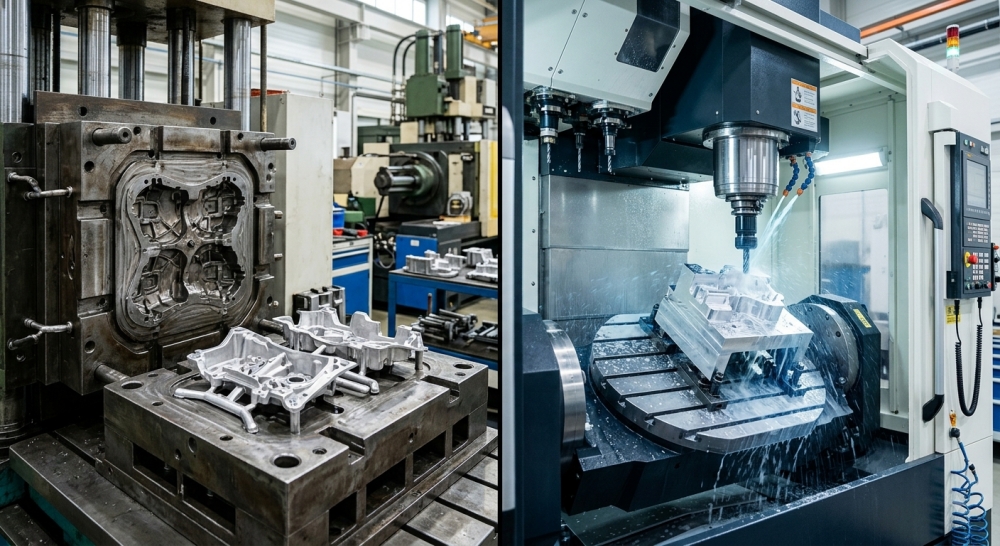
- Die Casting: A high-pressure metal casting process where molten non-ferrous metals (such as aluminum, zinc, or magnesium) are forced into a hardened steel die casting mold cavity at high velocity.
- Injection Molding: A high-pressure process where molten thermoplastic resins (such as ABS, PC, Nylon, or PEEK) are injected into a hardened steel or aluminum mold cavity.
- CNC Machining: A subtractive manufacturing process where computer-controlled cutting tools (mills, lathes, routers) carve material away from a solid metal or plastic block (billet).
2. Initial Tooling & Setup Cost Comparison for Your Die Casting Mold
Upfront capital requirement is a major differentiating factor when evaluating these manufacturing processes.
Die Casting Mold Tooling Costs
Because die casting involves high thermal shock and extreme hydraulic pressures, a die casting mold must be constructed from heavy-duty, premium hot-work tool steels (like H13, 1.2344, or SKD61). Molds require robust cooling channels, thermal expansion allowances, and heavy structural frames. Consequently, die casting tooling costs are higher than plastic injection molds and significantly higher than CNC machining setups.
Injection Molding Tooling Costs
Plastic injection molds operate at lower temperatures than metal casting tooling. While complex multi-cavity injection molds can still be costly, aluminum or standard P20 tool steel can often be used for lower-volume runs, making initial injection mold tooling generally less expensive than equivalent die casting mold tooling.
CNC Machining Setup Costs
CNC machining requires no custom hard tooling or molds. The initial investment consists purely of CAM programming, fixture design, and soft jaw setup. This makes CNC machining by far the cheapest option for low-volume production runs (1 to 500 units) and prototyping phases.
3. Per-Unit Production Cost Analysis across Production Volumes
While CNC machining wins on low upfront tooling costs, its per-unit cost remains flat regardless of volume because cutting tools must machine every single feature sequentially. In contrast, molding processes drastically reduce per-unit costs as volumes scale.
Cost Efficiency Break-Even Thresholds:
- Low Volume (1 – 500 parts): CNC Machining is the cheapest option due to zero mold tooling expense.
- Medium Volume (500 – 3,000 parts): Die Casting becomes competitive with CNC as rapid shot cycle times amortize die casting mold tooling costs over the production run.
- High Volume (5,000+ parts): Die Casting and Injection Molding dominate. Per-unit production cost drops significantly compared to CNC machining.
4. Material Cost, Structural Strength, and Mechanical Properties
Comparing unit cost is incomplete without evaluating material performance. A cast aluminum part cannot always be replaced by a plastic injection molded component.
Metal Strength vs. Lightweight Plastics
Die cast aluminum, zinc, and magnesium deliver superior tensile strength, thermal conductivity, EMI shielding, and structural rigidity compared to injection molded plastics. When a plastic part requires glass-fiber reinforcement or metallic inserts to reach target mechanical strength, the material and assembly costs can eclipse those of a single die-cast metal component.
Material Scrap & Waste Efficiency
CNC machining generates significant raw material waste (swarf/chips), especially when carving complex shapes out of large metal billets. Die casting and injection molding are near-net-shape processes, utilizing 90% to 95%+ of raw material, which directly lowers unit material costs for high-volume production.
5. Design Flexibility, Precision Tolerances, and Finishing Costs
Achieving tight tolerances directly affects total manufacturing cost.
Precision Capabilities of High-Quality Molds
Direct CNC machining natively achieves ultra-tight tolerances (±0.005mm to ±0.01mm). While raw die cast components typically hold ±0.05mm tolerances, incorporating custom high-precision mold inserts, core pins, and sliders built to 0.003mm tolerances ensures that shut-off lines remain tight, minimizing secondary post-machining operations.
6. Production Speed, Cycle Times, and Scalability
Production speed directly influences machine shop hourly rate costs:
- Die Casting Cycle Time: 15 to 60 seconds per shot (often casting multiple parts per shot in a multi-cavity die casting mold).
- Injection Molding Cycle Time: 10 to 45 seconds per shot.
- CNC Machining Cycle Time: 10 minutes to several hours per part.
For high-volume runs, a multi-cavity die casting die can produce thousands of metal parts per day, outpacing a battery of CNC machines at a fraction of the operational cost.
7. Detailed Process Comparison Matrix: Die Casting vs Injection Molding vs CNC
Review the comprehensive comparison matrix below to determine the best process for your production needs:
| Evaluation Parameter | Die Casting | Injection Molding | CNC Machining |
|---|---|---|---|
| Initial Tooling Cost | High ($5,000 – $50,000+) | Medium – High ($3,000 – $35,000+) | None (Only fixture/programming setup) |
| Per-Unit Cost (High Volume) | Very Low | Lowest | High |
| Material Options | Aluminum, Zinc, Magnesium | Thermoplastics (ABS, PC, Nylon) | All Metals, Plastics, Composites |
| Structural Strength & EMI | Excellent (High strength metal) | Moderate to Low | Excellent |
| Part Production Speed | Very Fast (15-60 sec) | Fastest (10-45 sec) | Slow (Minutes to hours) |
| Economical Break-Even | 3,000+ units | 1,000+ units | 1 – 500 units |
8. How Hairong Mould Technology Delivers High-Precision Tooling Accessories
Whether you are developing a new die casting mold or optimizing high-cavitation plastic injection tooling, component accuracy dictates mold life and part yield. Dongguan Hairong Mould Technology Co., Ltd. provides custom high-precision mold accessories engineered to withstand aggressive production environments.
Our Advanced Production Capabilities
- Precision Non-Standard Components: Core pins, cavity inserts, thread cores, ejector sleeves, sliders, and custom hardware/plastic mold accessories.
- Sub-Micron Tolerance Guarantee: Concentricity, roundness, and verticality maintained strictly within 0.003mm.
- World-Class Machining Fleet: Mazak and American CNC lathes, Sodick mirror EDM, Mitsubishi wire EDM, punch grinders, and cylindrical grinders.
- Quality Inspection & Assurance: Dimensional verification using German Zeiss 3D CMM and optical profile projectors.
9. Frequently Asked Questions (FAQ)
Q1: Is die casting always cheaper than CNC machining for aluminum parts?
A1: No. For prototype quantities (under 500 units), CNC machining is usually cheaper because you avoid the $10,000+ investment in a custom die casting mold. However, for quantities above 2,000 to 3,000 units, die casting is substantially cheaper per part.
Q2: Can plastic injection molded parts replace die cast aluminum parts to save money?
A2: Only if mechanical strength, heat resistance, and structural rigidity allow it. If a component experiences high stress, thermal exposure, or requires EMI shielding, switching to plastic may result in structural failure.
Q3: What alloy is the most cost-effective for custom die casting mold production?
A3: Aluminum ADC12 (A383) and A380 are the most widely used and cost-effective alloys for structural die casting, offering excellent fluidity, light weight, and mechanical strength.
Q4: How do high-precision mold inserts help lower overall die casting production costs?
A4: Inserts machined to ultra-precise 0.003mm tolerances prevent molten metal flash, ensure tight shut-offs, and reduce the need for secondary CNC trimming operations on finished castings.
Upgrade Your Tooling Precision & Reduce Production Costs Today!
Are you developing custom mold tooling or searching for ultra-precision core pins, cavities, and mold inserts? Dongguan Hairong Mould Technology Co., Ltd. provides reliable, high-precision custom mold accessories with tolerances maintained within 0.003mm. Contact our engineering specialists today to discuss your project requirements and receive a prompt quote!